Breakfast as usual (toast, jam, colacao) with Jennifer and then it’s off to school. It seems as though class starts earlier each day, but really it’s that I’ve just been staying out too late. Thank goodness I at least have all my work done.
Today is the day to present our first literal translations of the poems we’ve worked on in our small groups. Cortney, Carin, and I present our rough translation of Nocturno. We had a little trouble with how repetitive the sentence structure is—it sounds much better in Spanish than in the direct translation to English. I am beginning to truly understand how much more rhythm there is in the romance languages! Tony and Giuseppe assure us that we’re on the right track, but give us some direction (read: specific constructive criticism). It’s hard to imagine that an eleven-line poem could require so many drafts and revisions! It gets tricky because the three of us girls all have different ideas of what sounds good, what makes the most sense, and we all like different ideas. But that’s why the groups are helpful—the sharing of ideas will hopefully result in a better translation.
After class I take Isar to the supermarket. Isar is an Italian student and is feeling under the weather so we’re on a mission to find vitamins. We detour through the open-air market and look at the beautifully stacked vegetables and fruit. After a glimpse of a foot-lomg plus cown tongue hanging from a hook, Isar doesn’t want to take a tour of the meat section with me, so we bail and head to the supermarket. Sadly, the supermarkets in Spain are not the catchall shopping destinations like they are in the U.S. We don’t find vitamins and head home for lunch.
Isabel spoils me with seafood and today is no exception! Soup with giant squid called choco… it’s incredible! I always overeat at Isabel’s table and start cracking jokes about taking my food-baby to the beach. Where else would I spend my afternoon in Cádiz?
After the beach no one is at home in the apartment when I return. It’s cooled down a little bit, so I decide to go for a run. I brought all my running gear, and I’ve been far too lazy. I set out and am instantly grateful for my iPod and headphones when it seems like every guy on the street has a comment for the blonde girl jogging in leggings and a long-sleeved shirt. Too bad, I can’t hear you!
I run straight down my street until I meet the road that curves around the edge of the peninsula. I stay on the sidewalk as best I can, but this is not a pedestrian culture accustomed to runners. I get caught up behind people doing the Spanish shuffle and end up running in the street alongside the parked cars until I get to the wide camino that starts at La Caleta. As I get to the main entrance to the beach I run into Becky, Amy, and Megan who think I’m crazy for running in long legs and sleeves. More sweat! I explain. We agree to meet up later and I keep running. It seems like everyone is staring at me. I try to reason that it’s because I’m totally covered up, or maybe it’s because I’m the only female runner out, and one of the only runners period, or maybe it’s that in the wind my blond ponytail is screaming out behind me like a lion’s mane, or maybe it’s because I run funny…
When I get back, there’s still no one home, so I shower and get dressed for the evening. I call the girls to meet up with them and walk down to Plaza San Juan de Dios, which is almost to the Gate of Cádiz. They’re all eating at a little Andalucían restaurant with a friend Becky made while she was in Sevilla for the weekend. Nicolas is from Paris and is a very sweet, very French guy. His English is practically perfect and he speaks no Spanish. I’ve enjoyed the sort of international cast of characters that I’ve had the chance to meet on this trip so far. It’s always refreshing to have positive interactions with people from different countries and different cultures. Maybe I’ve grown up since I last traveled to Europe, or maybe sentiments have changed, but it seems as though I am more welcomed or accepted as an American than in the past. Perhaps it’s the promise of change…
We’ve been in Cádiz for one week now and we’ve managed to establish only two places to spend our evenings—we hit both tonight: the beach and the Irish pub. I pulled out my high heels for the second time this trip and end up trading shoes with Amy in the bar so she can learn to walk in heels! We manage to keep the evening pretty mellow and I’m not out that late… but it’s all relative.
Wednesday, September 10, 2008

Tuesday, August 26, 2008

Jennifer and I are up, but just barely since we both had late nights. We scarf breakfast and I happily take the gentle teasing from Isabel about my late night out (like a real Spaniard!) and the cute bartenders at O’Connells (apparently all of Cádiz considers O’Connell’s to have the cutest staff, who knew?). Isabel tells me to take a sweater and then hands us each two pieces of fruit to help hold us over til lunch. We scoot out of the building to meet a bunch of the girls at Plaza de San Antonio to walk to the embarcadero together. Today we’re off to take the ferry to Puerto de Santa Maria, the hometown of Alberti. Of course, we run into Giuseppe and Tony right in front of our building and have to admit that we have no idea where we’re going… Tony gives us vague directions accompanied by a few eye rolls before we part.
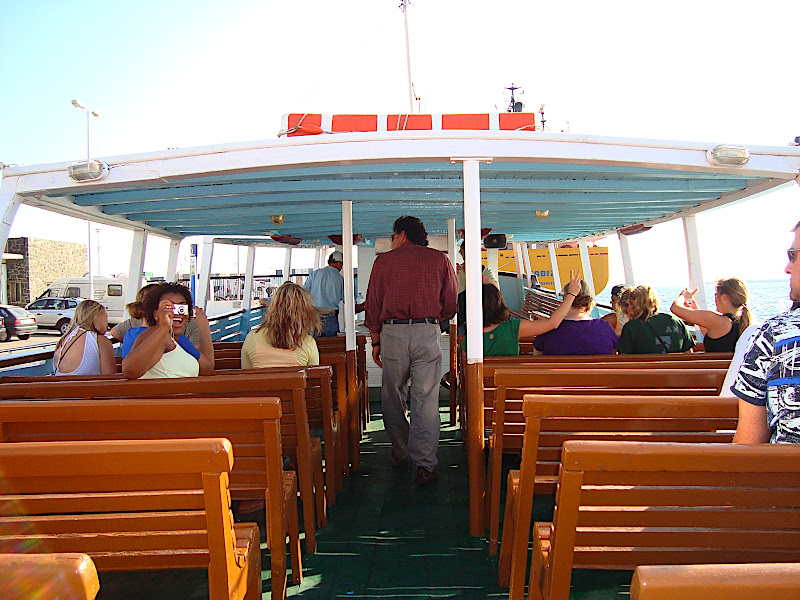
There’s no one waiting at Plaza de San Antonio. I thought this might happen. I make a few phone calls and it turns out everyone is meeting just down the street at Plaza de Mina… no problem, it’s a small city after all! We all meet up, finally, and walk past the Plaza de España (there’s one in every city!) to the Embarcadero. Some of the girls are looking pretty whooped from the night before and I’m not too sure that a ferry ride on the Atlantic is what the doctor ordered. I, myself, am really excited to take a boat ride, being a waterbaby. We board the Vaporcito, and award winning little ship that does nothing but ferry people from Cádiz to the Puerto and back all day long. We sit up top on benches and I realize, as it’s already 90 degrees at ten a.m., that the sweater I bought is totally useless. It’s a gorgeous day for sea-faring and the water is an amazing blue that stretches all around us. I can’t help but grin; I love the familiar rock of the boat and the smell of salt on the air. The ride is almost too short for me.
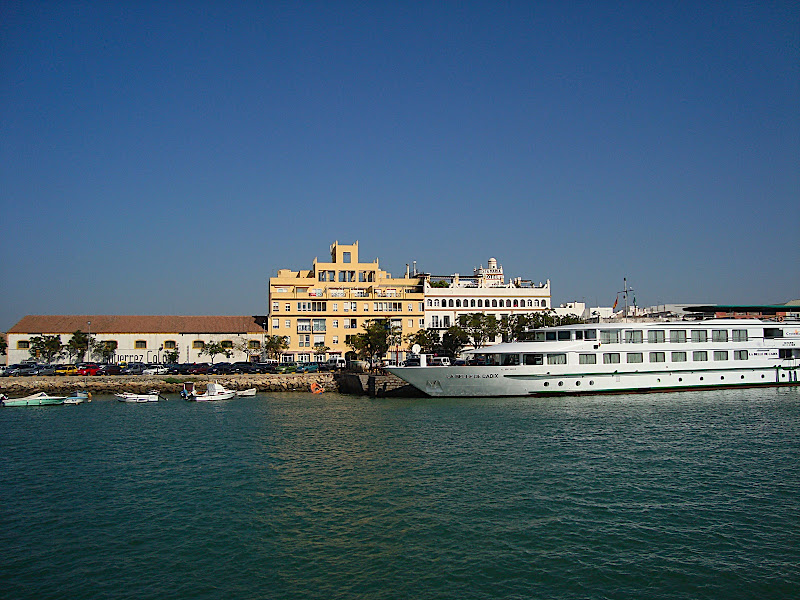
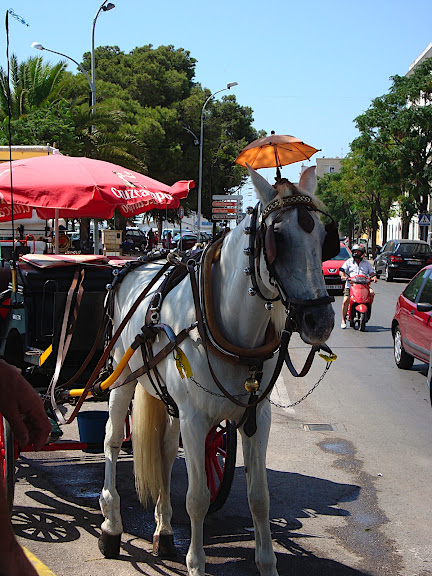
Puerto de Santa Maria is a small town, but a bustling one. In a weird way it reminds me of Mexico, perhaps of Puerto Vallarta. There are horse-drawn carriages waiting to collect tourists from the Vaporcito, but we’re a large group and we’re going to hoof it today. We’ve come to Santa Maria to visit the Alberti museum. Having heard the museum is actually in the building that was Alberti’s house here, where he lived after he returned to Spain late in his life, I imagine it being a very small and cluttered collection of his personal papers and sketches. I am not prepared for the treasure trove I discover the actual museum to be.
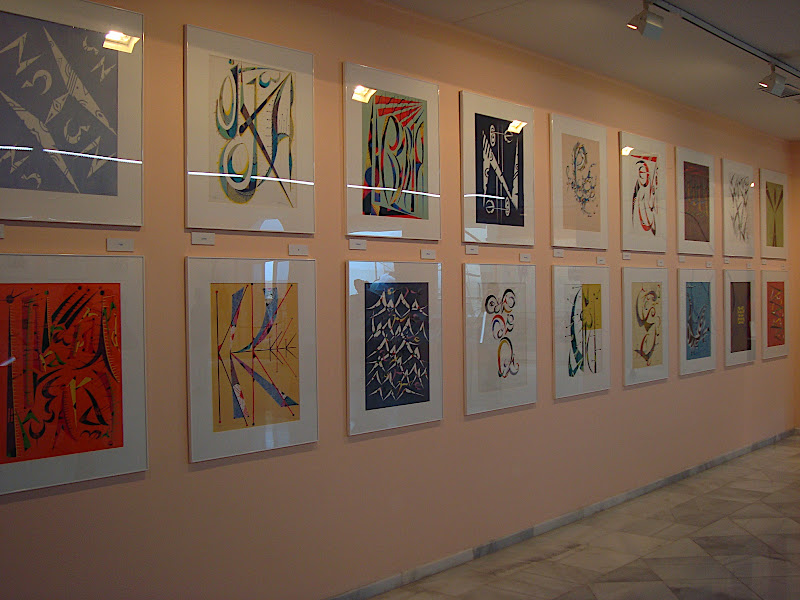
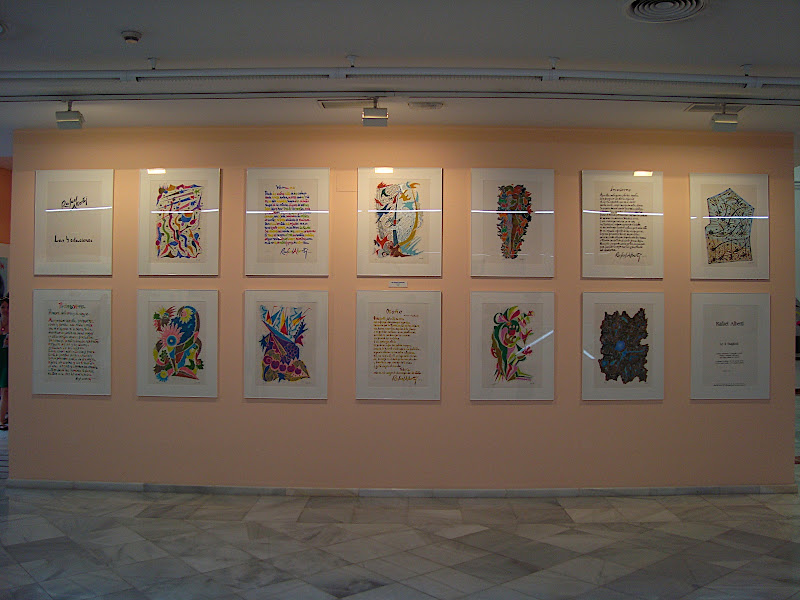
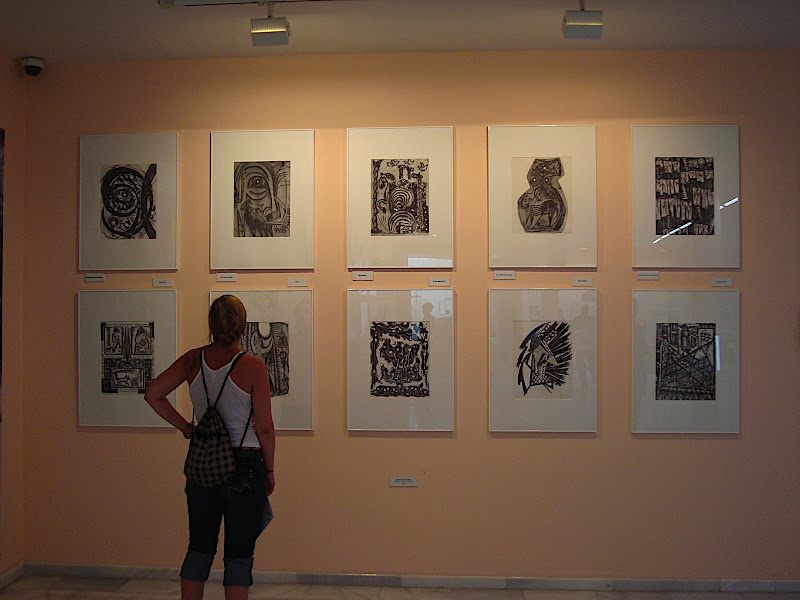
The house is grandiose inside, but modest from the outside and tucked between other buildings on an indistinct street in the town. The sala on the first floor is incredible. On one wall hangs the entire framed series of the letters of the alphabet, painted by Alberti. On the opposite wall hangs another series of his paintings called the Seasons. They’re incredible, vibrant, compelling pieces with shape and movement. The glass exhibit cases hold journals and notebooks, sketches and letters all in Alberti’s own hand.
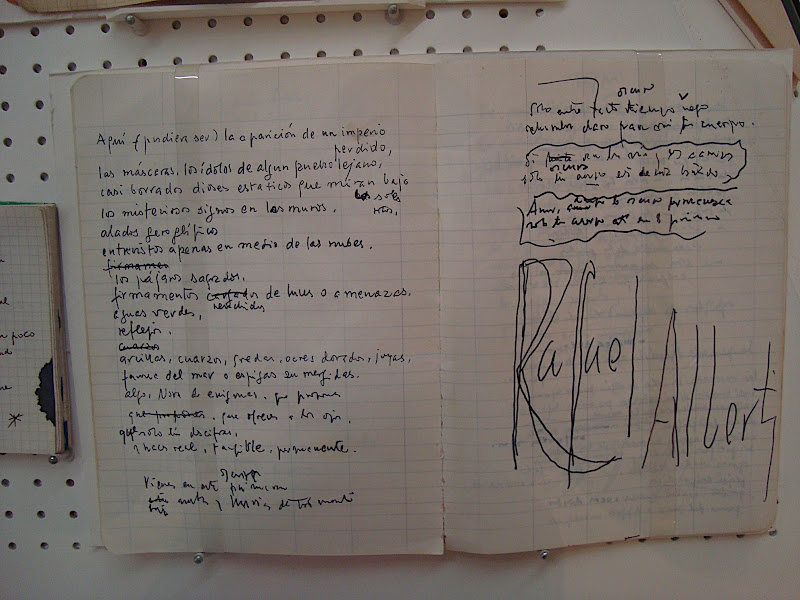
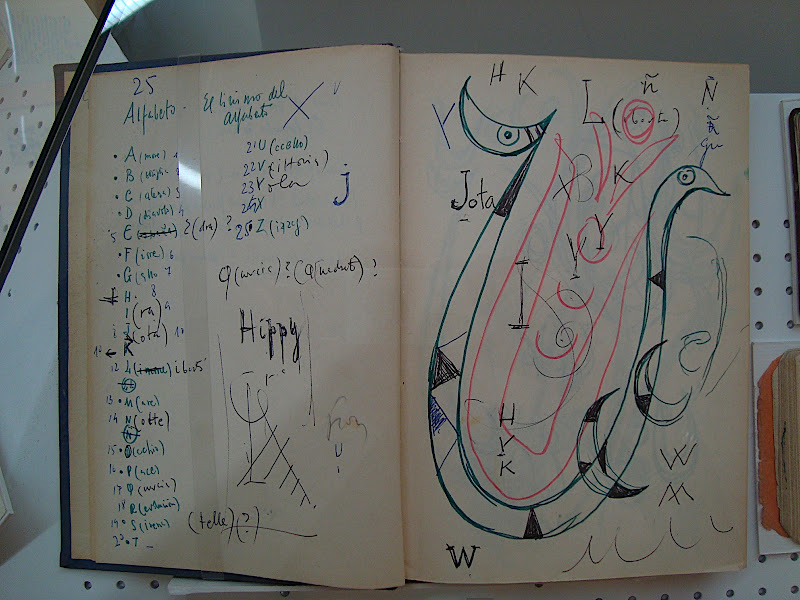
As I peer through the glass at one of Alberti’s journals I’m struck by the melancholy thought of how sad it is to have all of these personal writings and scribbles and to know that they come to an end. Here, in this house, is an incredibly collection of evidence of a single man’s vision and creativity. The paintings bring new life and value to the poetry and having read Alberti’s poems seems to infuse the paintings with greater meaning as well. His mediums truly seem to compliment one another, and here they are, side by side, where they can sing together.
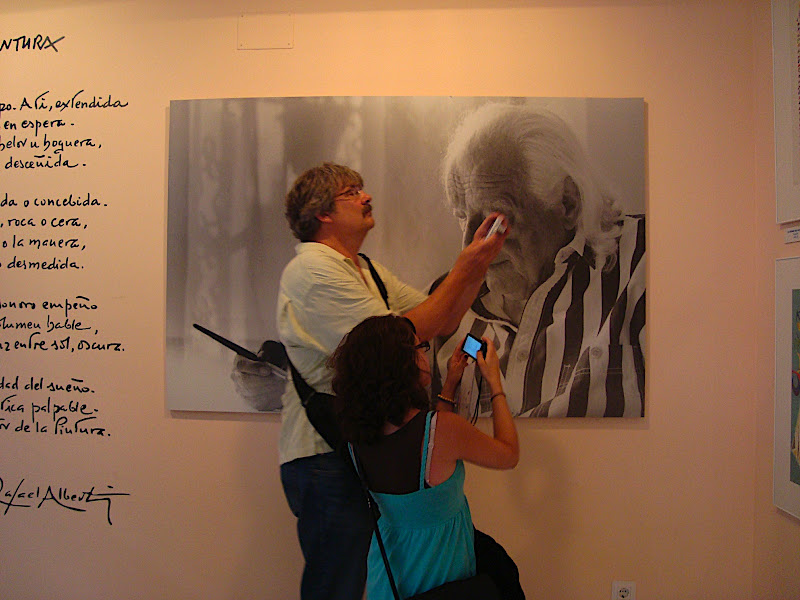
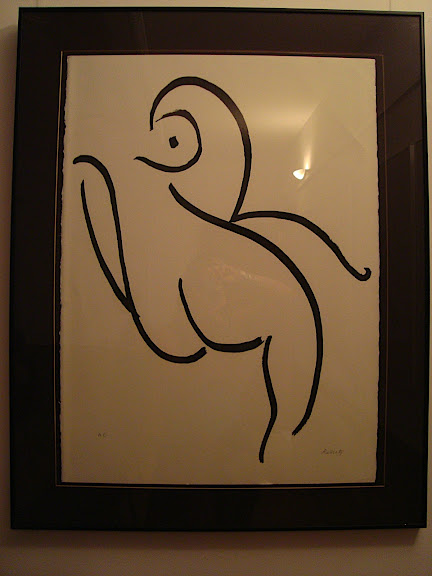
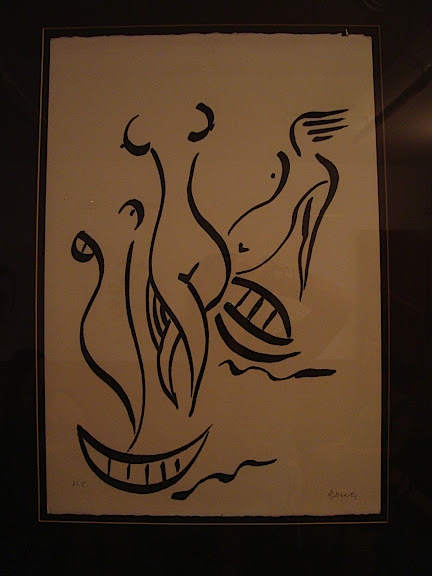
The upstairs sala has more of his free-form work as well as a series called “Los Ojos de Picasso,” a tribute to his dear friend, the famous artist. There’s also a small theater playing a short informative film on a loop, but the art in this room is some of my favorite. There is a series of paintings of figures, very simply depicted using only black paint outlines to create the images of women, or doves, or lovers embracing. The simplicity is beautiful.
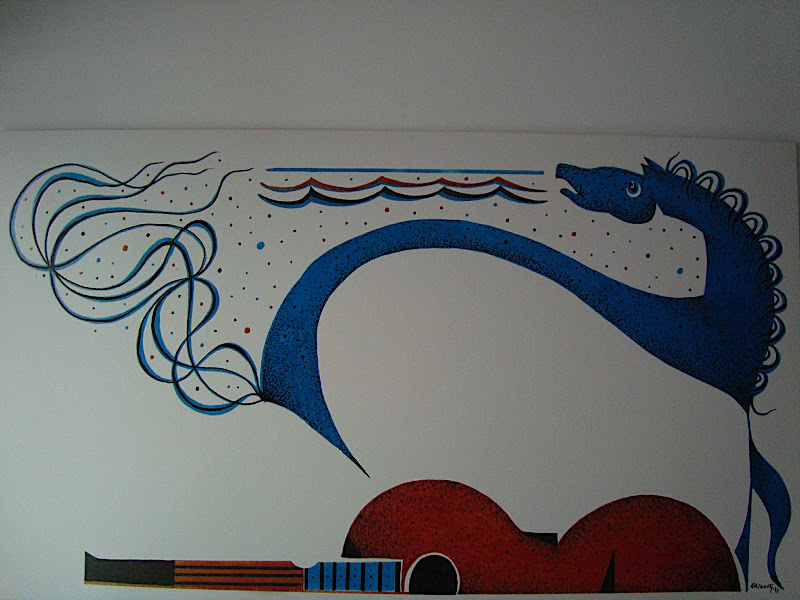
We collect in a small corridor that houses a large painting of a horse and a guitar. Tony points out how musical Alberti’s painting seem to be. It does seem as though this man had an internal rhythm that can be felt in the cadence of his poetry and the movement of his art. I believe that Spain, and particularly the south, is a very magical musical place. There is dance and rhythm throughout the culture of the country. The dance in the bullfight, the stomping beat of Flamenco and the chirping castanets of Sevillanas, the crescendo of the ocean, the wailing of gypsy songs, and the random singing of every member of my host family…
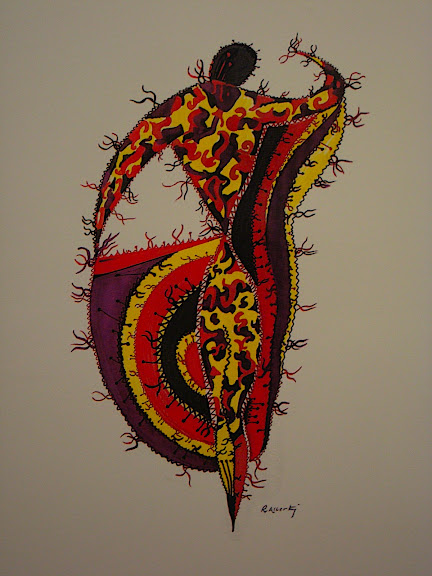
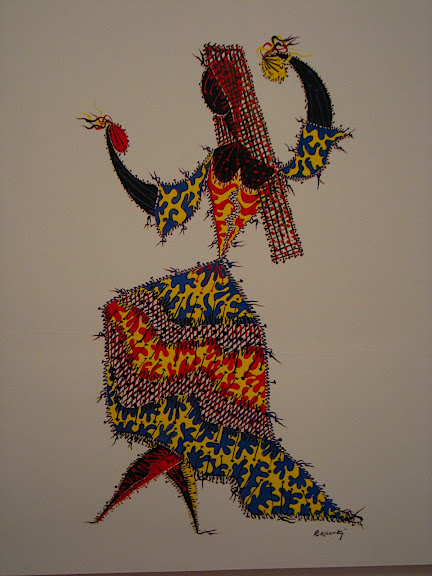
This museum is the highlight of my visit to Cádiz—here Alberti comes alive for me. We have read Alberti’s autobiography, The Lost Grove. While we don’t have time to search for the actual place for which his memoirs are named, there is great benefit to visiting the places mentioned in the book. Because Alberti is such a creative persona, I’ve had a hard time tamping down my skepticism about the accuracy of the stories in The Lost Grove. But getting to see the small town where he grew up, and just the ferry ride across the bay itself was enough to validate the memoirs, real or embellished. I am beginning to understand, just from getting a little older every year, that we become the people we are not because of what happens to us or what we live through, but because of how we experience, understand and remember all of it. From this perspective, I stand to learn more about Alberti as a soul from his imaginings and memories than from the most extensively researched and fact-based biography.
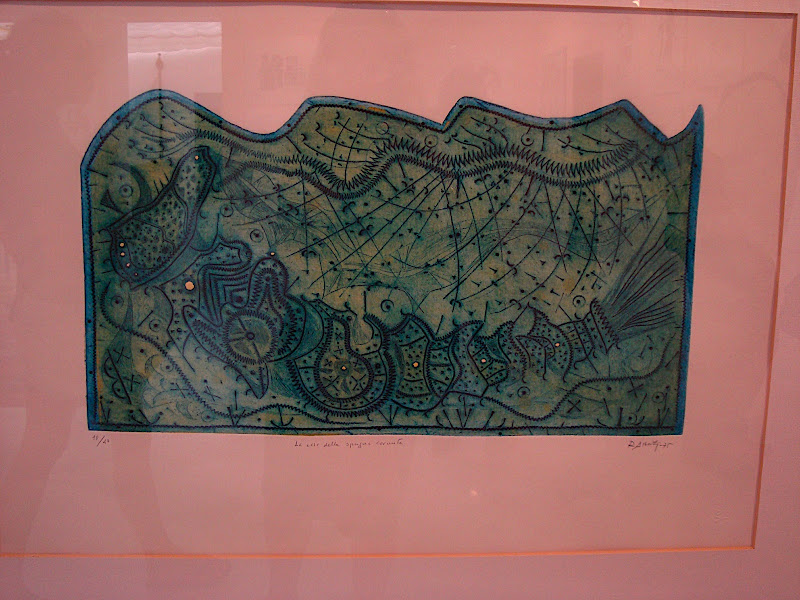
What I can’t help dwelling on, as we wrap up our tour of the museum, is that Alberti, as a young man, believed that he had to choose between devoting himself to being a painter or to being a poet. I don’t think I’ll ever know why he found the two impossible to co-exist within him. In fact, most of the art must have been created later in his life. In a way, that supports my suspicion that to only pursue one medium of expression would stifle creativity, or limit it, instead of the narrowing allowing one to expedite its development. If he returned to painting, he must have been drawn to it, and I can’t believe that he was ever able to truly quash that pull.
We have to make sure we catch the one p.m. sailing time for the Vaporcito so that we can all get back to Cádiz in time for lunch. Not wanting to be late, we hustle out of the museum and truck back through the streets to the waterfront. Of course, we’re early, so we take a few minutes in a café to hydrate since it’s insanely hot today. The winds have in fact shifted over the weekend, and we are now fully suffering the hot force of the Poniente, which brings heat and humidity with it.
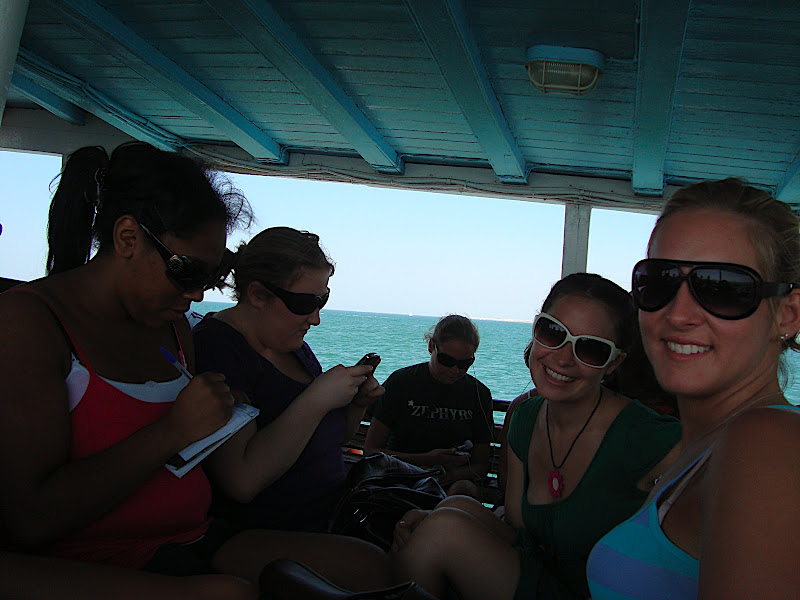
The ferry ride back is significantly more crowded, but a few of the girls find open benches and fall asleep. A small number of us entertain ourselves with a game. Everyone writes two lines of a sentence, you stop when you reach the end of your second line and then fold the paper so that the next person can see only the last line written. They continue the sentence and story, adding two lines of their own, then folding the paper again… and so on until you run out of space on the paper. Our story definitely didn’t make sense, but was entertaining and allowed lots of girls to play.
When Jennifer and I arrive, Isabel has lunch ready for us. She’s made spaghetti carbonara, which has chunks of ham in it, but she’s been so good to me thus far, so I don’t say anything and just eat around the ham. Of course, just when I’m almost done with my plate, Isabel notices and makes a big fuss of how she forgot that I don’t eat meat. I don’t mind at all and try to tell her not to worry, it was easy enough to eat around the bits of meat. Thank goodness she didn’t serve steak!
After lunch, to the beach! Most of the girls are there and it’s nice to be with a group of people so that I can leave my stuff while I swim in the ocean. The nice thing about the wind-shift is that the water seems cleaner, though the beach itself is still very much a giant ashtray. But in this heat, frequent dips are essential to staying cool.
We don’t stay at the beach too late, we have to report to “office hours.” Giuseppe holds his office hours for the Italian students at about seven in Plaza Mentidero (by the award-winning gelato joint) and Tony holds his office hours at a café in Plaza de Mina at about eight. Though very informal, these are semi-optional (read: in one’s best interest to show) meetings to speak in your respective language of study and to go over any of the material or work that is confusing. We are also supposed to be sharing our plans for our final projects. I shower and dress for the evening before trucking my computer down to the Plaza to use the internet and wait for office hours to commence. Only a little Spanish is spoken, perhaps because we are speaking so much of it in our homestays, perhaps because not everyone is as eager to chat as I am…
Morenita Megan and I are starving, so we head out to 100 Montaditos to get some cheap eats to go and do a little errand running. We come back to Plaza de Mina and I scarf my food while doing a little work on translating with Cortney and Carin. Rough plans are made to meet at the beach… I head back to the apartment, ditch my stuff, and then Jennifer and I walk down to the beach to see what’s going on.
The whole group (less my two translation-group members) has collected at the beach. We sit in a giant circle and spend an hour, at least, cracking up together before we migrate into town to where else? O’Connell’s.
Amy somehow is separated from the group, but ends up rolling in a little after the bulk of the group with five guys from Barcelona in tow. Now the girls in the group have to practice their Spanish—the only problem is that the Barcelona accent, and dialect, is way different!
We’re all out late again, living that “Spanish” lifestyle as only loud Americans in an Irish bar can…
Monday, August 25, 2008
I’m off to school after breakfast and the walk seems to take forever because I’m so tired from staying up late chatting the night before. We have our poem done, so I don’t have anything to worry about except for how awful our translation might be.
For this first attempt at a literal translation the entire class has worked on the same poem, Monsserrato 20, which is Alberti’s ode to his home in Rome. We are working from the text of one of Alberti’s collections called Roma, Peligro para Caminantes. This text has the poems in their original Spanish as well as Italian. It’s very useful to be able to compare the Spanish text to the Italian because the translation was done by a close friend of Alberti’s and worked with the poet closely while completing the collection. The Italian text is not always a perfect match to the Spanish, which actually bolsters us a little bit. It’s difficult and very intimidating to translate someone else’s work without feeling like you’re taking liberties you have no business taking.
Here is the original Spanish text:
Monserrato, 20
Desciendo la escalera de mi casa,
mirado de relieves. ¿Dónde sueño?
Dioses del mar y atletas coronados,
cabezas de guerreros, bailarinas
cimbreadas de finos tallos ágiles,
Leda ciñendo al cisne complacida,
letras insignes, lápidas y nombres…
¡Oh Roma deseada, en ti me tienes,
ya estoy dentro de ti, ya en mí te encuentras!
Me agrando o adelgazo por las calles y plazas
de este barrio que habito, junto al río,
barrio que me recibe embanderado,
como una barca, de tendidas ropas,
movido en cada puerta por millares de dedos,
de los que surgen, mágicos,
áureos ángeles, santos, cornucopias,
muebles nuevos con gracia envejecidos,
multiplicadas imaginaciones…
Ya estoy dentro de ti, ya a todas horas
en ti me muevo, nueva lengua tuya,
Roma en la noche, oscura voz de fuente,
Roma en la luz, clara canción de día.
Quiero perderme en medio de to aliento,
ser aire popular entre tus aires.
Ando buscando compañia, voy
entre gatos, columnas asombradas,
basuras, muros de potentes hombros,
puertas de colosales estaturas,
atónito, adorándote, riendo,
renegando, regando los rincones,
viéndome muerto, peatón humilde,
o jubiloso de sentirme a salvo,
renacido a la vida a cada instante.
Ando buscando compania, pero…
¿Quién se para mirándome, de pronto,
en el Campo de’ Fiori? ¿Quién insiste,
fija, tierna y burlona la mirada
entre un mar de verdures y pregones?
¿Qué me mira, señor? Nunco lo he visto.
Lo saludo con todo mi respeto.
¿Qué oculta en esa mano? –Lo imprevisto.
Es un soneto. Mi ultimo soneto.
Ma ttutt’a ttempi nostri! E ccaristìa
e llibbertà, e ddiluvi, e ppeste, e gguerra,
e la Spagna, e la Francia, e ll’Inghirterra…
—Veo, señor, que está usted muy al día.
—Es el 2200… —¡Ave María!
—…79. Mi ultimo soneto.
Me estremece encontrarle en esta plaza.
Te conozco. —Voi sete furistiere…
—Te lo digo en secreto, yo ando a caza
de un soneto también, de otro soneto.
—Povera Roma, oh Dio! Miserere!
—Por este encuenro, ¡un frasco de buen vino!
—Indove voi trovà ppiú mmejjo cosa?
—En tu lengua inmortal, más peligrosa
que las Tijeras del señor Pasquino.
Deja, mi Belli amigo, que en tus manos
te ponga ahora, ya perdido el miedo,
sus sonetos romanos
un hijo de los mares gaditanos,
nieto de Lope, Góngora y Quevedo.
Here is our English translation as completed by the entire class:
I descend the stairs of my house,
looked at by bas reliefs. Where am I dreaming?
Gods of the sea and crowned athletes,
heads of the warriors, flexible
dancers swaying with fine, limber waists,
Leda in pleasure wrapping herself around the swan,
noble letters, plaques and names…
Oh dearest Rome, in you, you have me,
I am already inside of you, already in me you find yourself.
I grow and shrink in the streets and plazas
of this neighborhood that I live in by the river
that receives me with flags unfurled,
beaconed to from each doorway by thousands of fingers
moved by every door through thousands of fingers,
from these appear
golden angels, saints, cornucopias
new furniture with gracefully grown old,
fantasies…
I am already inside of you, now at all times
I move around inside you, your new tongue,
Rome at night, dark voice of the fountain,
Rome in the light, clear song of the day.
I want to lose myself in the middle of your breath,
To be the wind of the people among your other winds.
I am looking for company, I walk
amongst cats, astonished columns,
piles of trash, walls with big shouldered,
doors of colossal stature,
astounded, adoring you, laughing,
cursing, watering the corners,
seeing myself dead, a humble pedestrian,
now jubilant to feel safe,
reborn with each instant.
I am looking for company, but...
Who stops looking at me, suddenly
in the Campo de Fiori? Who insists,
fixed, tender and teasing the gaze
between a sea of vegetables and street venders?
Why are you looking at me, sir? I’ve never seen you.
I greet you with all my respect.
Why is he hiding in that hand? –The unforeseen.
It is a sonnet. My latest sonnet.
Ma ttutt’a a ttempi nostri. E ccaristia,
e llibbertà, e ddilubia, e ppeste, e gguerra,
e la Spagna, e la Francia, e ll’Inghirterra.
-I see, sir, that you are very up to date.
-It is 2200…-Holy cow!
-…79. My final sonnet.
It surprises me to find you in this plaza.
-I know you. –You are a stranger …
-I tell you in secret, I am stalking
a sonnet also, another sonnet!
-Poor Roma, oh God! Miserere !
We celebrate this encounter,a flask of good wine!
-Indove voi trová ppiú mmejjo cosa?
-In your immortal language, more dangerous
than the scissors of Sir Pasquino
My dear friend Belli, he leaves,
without fear, entrusted in your hands
his roman sonnets
this child of the Cadiz seas,
grandson of Quevedo, Lope and Góngora.
It’s nice to have the input of the whole group in order to come to a common understanding of how to represent the poem in English. I do start to think about how different it will be when we break into our smaller groups to work on our assigned poems and sonnets. Each group has two Spanish students and one Italian student. We will translate two poems of free verse and two sonnets.
We will be posting our work online in an online forum hosted by the University of Washington. This will allow both our professors and our fellow students to read all of the work done by the class as well as leave suggestions. Our classroom at the University of Cádiz also has wireless internet, so those of us with laptops can access the poems during class, as we go over them.
I think this particular poem is an interesting one to start with. It’s an easier structure because it’s free verse, so we don’t have to worry about syllabic count or much rhyming. However, it’s especially difficult because Alberti includes dialogue and Roman dialect which make this piece a little more conceptually challenging. For me, the most difficult aspect of the poem is understanding the verb tenses and sentence structures correctly. It’s been four years since I’ve taken a Spanish class, which puts me at a disadvantage because all of the other Spanish students have taken class recently, and most have completed much higher levels than I have. They are working with a much stronger foundation in Spanish grammar, which is a little intimidating for me. I suppose what I’m banking on is my love of the language and my belief that some things are written in stone, not in sand, and it will come back to me.
I want to post this poem specifically because of how beautifully I think it conveys Alberti’s relationship with Rome. Being Gaditano (from Cádiz), Alberti had a passionate relationship with the sea and a deep love for his home. Rome is dramatically different from little Cádiz in every way it seems, and even after being displaced from his native land for so long, Alberti writes fondly of the beauty and of the ugliness of the city. I’m particularly moved by how, as an ex-pat, Alberti embraces Rome without losing his identity as a Spaniard. The duality this requires, straddling two selves, seems impossibly hard for me. Especially as I can’t stop thinking about how much I would love to move to Spain. But how does one resolve the conflicting pulls to love where you are from and where you are going?
After class I’m home for lunch with the whole family and we’re eating lentils! Isabel explains to me that her grandson loves lentils and since he’s eating with us, she’s made them especially for him. I notice that my generous bowl of lentils has been lovingly served without the giant chunks of chorizo that dot everyone else’s plates. I tell Isabel that I love to cook lentils at home and we chat about the differences in our preparation. Then the rest of the family sits down and the conversation turns loud and jovial as the two grandsons clown around, calling Mirella “la gorda mentirosa.”
After lunch I start in on my work, having decided to take a day off from the beach. I don’t get too far into it before Jennifer arrives. We greet each other and then Isabel, ever the hostess, ushers Jennifer into the kitchen for some food. After Jennifer gets settled in, I offer to take her to the beach and for a little walking tour of Cádiz. We walk together to La Caleta and even though it’s late in the day the sun is still strong and the beach is still busy. We stay for only an hour before walking back to the house. I explain to Jennifer that Cádiz is tiny, but it’s easy to get lost when you miss your turn or walk just a little too far. The good news is that you can only be lost for so long before you run into the ocean—it only takes about fifteen minutes to walk across the peninsula.
Jennifer goes out to dinner with Giuseppe and Tony and I get ready on the early side to go for a paseo around Cádiz. This is turning out to be one of my favorite evening activities. Since dinner isn’t usually until ten or so, I almost always have a little time between getting home from the beach and when the group meets up to eat. I like to stroll by the big plazas in the city and see all the families out together. The parents are always dressed nicely and the kids all seem to run in packs. I love how the older Spanish women dress, very elegantly and often with a refined simplicity that seems so European. Perhaps in the south a good tan is the only accessory a woman really needs.
I walk through the usual plazas and head for the small and crowded shopping neighborhood. The hours of six to nine are the primo shopping times for almost any city in Spain. It’s cooler and the shops usually close for siesta, so this is when things get taken care of. I discover that some things are culturally universal: the husband/boyfriend patiently holding shopping bags and waiting while his wife/girlfriend peruses piles and racks of clothes and shoes…
I wander back to Plaza de San Antonio and watch, horrified, as two kids next to me on the bench, a brother and sister both adorably dressed in seer sucker shorts and white collared shirts, smack each other repeatedly while their mother talks on her cell phone. Ah, Spanish parenting. I try her technique and get on my phone to call Courtnuts and Anita, who will meet me in a few minutes. I still can’t tune out these bickering kids. As I’m about to get up and move on, the threat of getting smacked in my own face increasing as the siblings’ fight escalates, I see Jared and flag him down. What luck! He and some of the girls are meeting to get pizza… at Telepizza which is sort of the Pizza Hut of Cádiz. We all split the bargain offer and get three pizzas and two liters of soda. Megan is particularly excited about the gift with purchase because it’s a inflatable floaty-chair, but tragically beach toys go fast in this town and they’re all out.
We all agree that Telepizza isn’t bad as crappy cheap pizza goes and we leave satisfied. There’s very little discussion involved in where to go tonight, the general consensus is to head to the Irish bar by Plaza San Francisco. It’s a short walk and we’re there pretty early as nightlife goes for Spain. In fact, we’re the only people in the bar, but that doesn’t really matter. We’re a big group of American students, in an Irish bar, on a Monday night… we’re loud and flamboyant and everyone is drinking and laughing and playing darts. One of the bartenders speaks great English, but we learn from him (in Spanish, mind you) that this is the hotspot for all of the American students. Because most of the American students in Cádiz come on direct exchange with UW, we’re not surprised to suddenly notice evidence of Seattle guests all over the bar, including a piggy bank with the Space Needle painted on it.
Anita is not feeling the music, which is mostly older American soft-rock, but when she asks for a little hip-hop she is turned down swiftly by the bartender in charge of the tunes. Anita is now determined to make this guy some cds and educate him. Especially if the UW-Cádiz students are arriving in a week—this place needs a little infusion of top-40. Despite the less-than-ideal soundtrack for the night, fun is had by all. We close the place down!
As I get in, quietly sneaking through the front door, I notice that the light to my room is on… Jennifer is still awake! She assures me that she wasn’t waiting up, but rather Giuseppe bought her an espresso at dinner and she actually can’t sleep. Even if that’s not the truth, I feel less guilty and crash out. Class is at ten, after all, and we have a field trip!
Sunday, August 24, 2008
I’m getting better at sleeping in, but in a house full of loud Spanish people, it’s still difficult. I eat breakfast alone, but Isabel keeps me company in the kitchen. It’s almost more fun to get up late because the rest of the house is awake and functional and willing to interact with me so I get to speak a lot more Spanish.
Isabel explains to me that on Sunday, especially at the end of vacation, everyone goes to the beach. She warns me that shops will be closed and that the beach will be very, very crowded. She’s already preparing lunch for the whole family to take the beach. She’s making tortilla Española, because I requested it, and explains to me the steps involved as she beats eggs in a bowl. She chuckles as she tells me that all the American girls who come to live with her make the same mistake—they never fry the potato and onion ahead of time. I don’t tell her that I’ve made this mistake too, and watch hungrily as she dumps cubed potato and diced onion into a deep pool of hot olive oil.
I eat my breakfast of toast and jam and colacao then head out with my computer to use the internet at the Plaza. Then I take a nice long walk and loop back to the house to pick up my lunch and get ready to meet everyone at the beach at two. When I get back to the house everyone has already gone to the beach. It makes me smile to discover my lunch waiting for me on the kitchen table and I think of how my dad made me lunches almost every day growing up. It’s nice to feel cared for when you’re thousands of miles away from home. Isabel has left me a bocadillo de tortilla, wrapped in foil, a bag of fritos (just like my dad did!) and three pieces of fruit.
I tuck my lunch away in my bag, change into my suit and hoof it to the beach to meet up with everyone. This is the on-time crowd, so I make sure to get to the meeting spot with time to spare. Jared and Isar are the only ones joining me today and we decide to walk all the way down the peninsula to the “new beach” called Santa Maria. It’s insanely hot, probably because the wind has shifted from levante to poniente and blows hot. The walk isn’t too bad, but by the time we get there we’re more than ready to get in the water.
The beach is insane! There are people everywhere and brightly colored umbrellas obscure the sand and stretch on as far as the eye can trace the coastline. It’s like a scene from Where’s Waldo. We marvel at the view, it seems as though the entire population of Cádiz really did show up to the beach today. We decide to climb over part of the retaining wall to a little sliver of beach with only a handful of people. It’s quieter and even though there’s less beach we pick a spot and spread out.
I dig into my lunch and then can’t wait any longer and plow into the water. This beach has waves! They’re fairly big too, and I get slammed around a little bit before I find my sea legs, so to speak. The sun is strong today and we’re out a little earlier than usual because we brought our lunches. By the time we leave the beach at about six, we’re all exhausted from sun exposure and even though I’m not burnt, I can tell that I’m going to take the next day off from the beach. There is, after all, such a thing as over doing it.
We set out to walk back, but I ask if we can take a detour inland to cross under the gate of Cádiz, which separates the old part of the city from the new. We pose for photos and Jared points out the rows of cannons perched on the edge of the wall, probably just for decoration at this point. We continue on our walking tour of inner Cádiz, embracing the Spanish stroll and taking our time. We pass the Roman Theater, which is the ruin of an amphitheater built when the Romans ruled the Iberian Peninsula. Oddly, this is probably not the oldest relic this little town can boast of—the Phoenecians must have left something behind too. But the Romans have left a more lasting imprint, including the name of the city itself. The latin name was Gades, from which the term Gaditano (a person from Cádiz) comes.
We cut around the ruins and wind around the streets until we come to the Plaza de Catedral. The birds of prey exhibit from the fair the night before is open and we stop to look at all the owls and hawks. We take photos and then continue on our stroll back home. We wander through the shopping district and split up as we get closer to the heart of old Cádiz. We’ve made plans with Carin and Cortney to meet up at Plaza de Mina to eat dinner at a tapas joint. I’m really excited because not only is it one of the restaurants recommended by Jennifer’s friend, but this will also be the first time that Carin has come out to dinner. Plus, there will only be five of us, which is a rather nice number for dinner and much more conducive to fun having by all…
When I arrive at the house there’s still no one home! They must be at the beach or at least on their way home. Isabel did mention that she and the family were going to a beach even further past Santa Maria, but when I asked here where it was, she winked at me and said it was a secret and if I wanted to know I’d have to come with her. Keeping this in mind, I wasn’t surprised when still no one had arrived by the time I left to meet up with everyone.
We meet at eight because the restaurant recommendation came with an advisement to arrive early since it’s a popular place and fills up quickly. We mosey down the street, but the restaurant doesn’t open until eight thirty so we just keep moseying until we get to the end of the line which is a lovely walk way along the edge of the peninsula (to the north) where you can look down over the water. The light is gorgeous and we joke around and take photos until it’s time to head back to the restaurant.
One of the meseros helps us push two tables together in the bar area and we sit, trying to decipher the menu (again, we have no idea what any of the food is) and suddenly I realize that hanging above us is a line of ham shanks with plastic cones stuck in them to catch the dripping. I quickly move seats to sit on the other side of the table where I don’t have pig carcass overtop of me. We decide on a few tapas to order and I take the menu up to the bar and chat with the mesero about our choices. He recommends a few other dishes, which I agree to and then we wait to see what exactly we signed up for.
We order a tortilla Española with salsa brava—only it turns out Carin hates ketchup and that’s basically what salsa brava is… and huge chunks of grilled tuna, some roasted vegetables with a fried egg, meatballs, and an Iberian beef dish that everyone thinks is to die for. I order more of the stuff everyone likes and Cortney takes the initiative and orders some giant fresh tomato tapa that she saw at another table. Everyone gets enough to eat and when the bill comes and we split it up it’s only three euro for the kids without drinks and four euro for the kids who got drinks. What a deal! The food wass great, and we all had a fabulous time at dinner eating family style with a nice comfortable group.
We walk to Plaza Mentidero to the award-winning heladeria to get some icecream and then decide to wander down to the Plaza de Catedral to see if the Andalucia fair is still in swing. We get down there at about ten thirty and the woman in the big tent in the plaza tells us that the fair ended at ten. Unphased I plow through the crowd, getting stuck for a moment behind a couple that is walking so unbearably slow while weaving back and forth making it impossible to pass them, but we all finally get around them and I lead everyone to the small silver jewelry stand I had seen the night before that all the girls wanted to go to.
The couple selling the jewelry have packed up, but I explain that I was there the night before and that I brought my friends who are interested in the coin bracelets they have. The young woman assures us it’s no problem and she and her boyfriend dig around in their collection until they extract a fistful of bracelets for the girls to look at. I chat with the young woman while the girls shop, discovering that she and her boyfriend are going to India in a few months. They’re originally from Argentina, but have been traveling the world. When we part I wish them safe travels and she thanks me for bringing my friends back. I think that running into people from all over the world have been the richest experiences I’ve had in Spain.
We all walk Isar home since she lives on an extremely sketchy street and then slowly part ways as we get closer to our own houses. I’m happy to call it a night, we all have class the next day and it would be nice to get some sleep again. When I get home Isabel and Debora are in the living room watching the movie Pollock on TV. They invite me join them so I sit down and watch the rest of the movie with them. Of course, watching a movie with these two really means gossiping through the whole thing, which is great because those are always the conversations where I learn the most about colloquial Spanish.
After the movie we keep watching TV. Spanish TV is mostly shows from the U.S. that have been dubbed in Spanish. I think Europeans must believe that the only sort of people in the States are those who commit crimes and those who solve them, or that the only jobs available are policemen, lawyers, and detectives. Somehow we get on the topic of plastic surgery and the difference between what is legal to do in Spain and what is legal to do in the U.S. As it turns out, the U.S. has more lax laws about cosmetic surgery. The conversation then switches to an intense discussion about good-looking men. Debora rebuffs my fawning over Rafael Nadal, criticizing him for having small eyes and a small mouth. I roll my eyes at her and suggest that her perfect man must be Ronald MacDonald with the big eyes and the giant mouth. Isabel thinks this is hilarious and agrees with me that Nadal is quite a catch.
We end up discussing Spanish athletes and I have a hard time keeping up when the conversation switches to soccer because I’m really not that familiar with all the players here. It’s really interesting to hear the gossip about David and Victoria Beckham since Beckham left Real Madrid and signed with L.A. Galaxy. Apparently everyone in Spain really loved Beckham, even though he made piles of money but didn’t seem to play that much because he was always injured. But no one in Spain liked Victoria, a.k.a. Posh because she was rude and very critical of Spain.
All of a sudden I realize it’s about three thirty in the morning and I take myself to bed. I have to be up and at school at ten the next day. I know I’m going to be tired, but it’s these happy conversations in Spanish that really make the whole homestay experience important.
Friday, September 5, 2008
Saturday, August 23, 2008
I sleep in today—and I need the extra hours badly! Most of the girls have gone out of town and so I have no plans and no place to be today. As I’m lying in bed, having slowly woken up, I hear Isabel and some man talking about crab. “Cangrejos tan grandes!” (What big crab/These crabs are huge!) As I get dressed I hear them still fawning over these giant crab. When I finally make my way to the kitchen for breakfast I am expecting to encounter some giant sea monster of a crab displacing the normal contents of the kitchen with it’s huge claws and spindly legs… Instead I discover a foil sheet with rows and rows of the smallest hard shell crab I have ever seen. They’re about the size of the palm of my hand—and I have small hands! They’re like miniature Dungeness crab and I’ve never seen anything like them in my life.
I stand at the counter, staring at these baby crab, thinking they must have been joking, but no, Isabel turns to me and says, “Hey, how huge are those crab?!” I explain to her, laughing, that I heard them talking about huge crab and expected something enormous and I hold out my arms wide. I show her with my hands how big the crab are at home and explain that these look like the babies of the crab we eat in Seattle. Apparently in Cádiz, the crab are generally very, very small. These crab are in fact, large, as crab in Cádiz go (Debora will explain to me later that the crab are over-pulled and have no time to grow any bigger). Isabel explains how to eat a teeny-tiny crab, and I can tell she’s really excited about this special treat.
After breakfast I take my computer to the Plaza de Mina to check my email and do some work. It’s still pretty early and it’s fairly quiet—no screaming children… yet. I have an email from Jennifer, the advisor for the French and Italian department who will be joining us for a few weeks of the exploration seminar. The email is friendly and she tells me she’s arriving on Monday instead of Sunday and then includes a whole bunch of recommendations for restaurants and ice cream from a friend of hers who lived in Cádiz. I write down the names of the restaurants, but I’ve already been to some of them and have definitely had ice cream at all of the helado joints mentioned—I’m kind of proud that we’ve already managed to scout out a few of the places.
It’s not long before my computer battery is dead and it’s time to head back for lunch anyway.
Lunch, like I may have mentioned, is the big meal of the day in Spain. Today, lunch is the big meal in the sense that the whole family is eating together. Abel and Isabel’s other grandson are here, plus Debora, Isabel’s son Ezekiel, Mirella, and one of Isabel’s daughters, who doesn’t eat with us. We all cram in around the kitchen table and I feel completely at home as the volume of conversation rises and the family seems to really enjoy each other’s company.
Isabel serves me some sort of thick tomato sauce with a fried egg, which I scarf down. Then comes the fish sticks, the little patties of fish roe, and dumplings of breaded and fried crab meat. Oh, and let me not forget the ensalata mixta! Food is love in this and every house along the Spanish coast.
I’ve discovered that Spaniards have a different concept of what mayonnaise is used for. Generally, my understanding has been that mayonnaise is used sparingly and is often thought of as a very unhealthy condiment. In Spain it is a dipping sauce, a spread for crackers, and a topping for hotdogs, frequently abused in the same manner in which I abuse ranch dressing. [On a side note: there is no such thing as ranch dressing in Spain and I’m feeling its absence. The closest thing is ali oli, which is not the same at all.] I sit and stare in wonderment as everyone at the table squirts huge dollops of mayonnaise onto their fish sticks and crab dumplings. Isabel squirts gobs of it on each of the little roe patties and then puts a few on my plate. Oh well, when in Spain…
Lunch is my favorite part of the day I think. I love getting to chat with everyone, although I have to say that part of why I love it the opportunity to just listen to everyone speaking Spanish around me. I learn most of my new vocabulary and phrases around the lunch table. Everyone is so patient and nice and they never mind when I interrupt to ask what a word or a phrase means. Sometimes I don’t even have to ask, they just turn to me and explain. I feel very included—which is such a pleasure.
During lunch Isabel’s mother calls. Isabel is an only child and her mother, as I understand it, likes to call and complain about how awful everything is in order to get some attention and a little sympathy. This bisabuela is incredibly hard of hearing and I can hear her shouting into the phone. Isabel shouts back, having to repeat herself two and sometimes three times while the whole family snickers. Then the phone is passed to Ezekiel who has a grand old time playing with his grandmother at her expense, giving one answer the first time he replies, then a totally different answer when he has to repeat himself, shouting at the top of his lungs. Of course it’s a grand performance and one that isn’t lost on me.
Bisabuela: “Where are you living? Madrid is a dangerous city!”
Ezekiel: “I’m very safe, I live in an apartment with my boyfriend.”
Bisabuela: “WHAT? WHO DO YOU LIVE WITH?”
Ezekiel: “I LIVE IN AN APARTMENT WITH MY CAT!”
Bisabuela: “WHAT?”
Ezekiel: “MY CAT!”
For dessert I get to try a cactus fruit called higo chombo. It’s delicious. It’s about the size and consistency of a peeled kiwi, but not acidic or sour at all, just sweet and delicious. I eat two—a red one and a green one. The green one is sweeter. After lunch I pack up my bag and head to the beach. I’m hoping that maybe some of the remaining girls will be at our usual spot, but I’m all by myself today and it’s kind of a nice, quiet change. I read and soak up the sun until it’s time for me to head back home to get ready for the evening. I’m supposed to be meeting my group at about seven to go over our poem translation. I shower and put on a nice dress and a bright green necklace I bought from a chain-smoking gypsy at Plaza de las Flores yesterday after the market with Megan. I even put on high heels for the first time since I’ve been in Europe in an effort to embrace the cultural tradition of dressing up for the evening paseo. I grab my computer bag and head for the plaza. I’m early and I sit and make some phone calls while I scan the gathering crowds for my group members. I can’t see anyone and it’s getting late… I figure they all bailed so I drop my computer off at the house and then head out for a leisurely stroll.
Isabel had mentioned a fair going on in an area called el Popolo. It’s off to the side of the Plaza de Catedral so I head that way because the cheap sandwich shop is there and I’m eating by myself anyway so I might as well eat cheaply.
As I come into the plaza there are people everywhere. A huge exhibit of photos, blown up and mounted on stilts forms an informal outdoor gallery in front of the cathedral doors. A large painted tent crouches in the far corner that leads to el Popolo. I’m determined to eat something first so I brave the crowded restaurant and place my order. As I’m waiting for my name to be called (I submitted it as Lucia since no one can say my name here) a little boy walks right up to me and just starts screaming at the top of his lungs. At this point I’ve gone a little too long without eating anything and it’s crowded and I just want to get my food and get going and here’s this kid screaming his head off right in my face. I look his mother dead in the eye and tell her in my most vicious Spanish that her child is the worst behaved child I have ever seen. She grabs him by the arm and yanks him away. Wise woman.
I’m much more pleasant after eating and wander over to the tent to see what’s going on. What’s going on is basically the U-District Fair of Cádiz. This tent happens to be selling some Moorish treats and a whole bunch of Moorish art. Beautiful, but not very well-made jewelry boxes with inlaid shell or stones and mosaic wood decorations can be had for only slightly inflated prices. Mosaic mirrors and glass lanterns, scarves and ceramic vases all wait for someone to take them home. I pass on all of it, having no room in my suitcase, no money to waste, and no interest in stuff that can be found of better quality and cheaper price elsewhere.
I wander into the streets of el Populo, noting the flags hung from the buildings announcing that this is a fair to celebrate the roots of Andalucía. The name for this region of Spain actually comes from an ancient Arabic word meaning the land of the Vandals. The Moors ruled the Iberian peninsula for an insanely long time, perhaps so successfully because they allowed the various cultures and religions of the area to continue to live life freely. Many Spanish words actually have Arabic roots instead of Latin. Rio, the word for river, is Arabic in origin. The architecture of the Moors can be found across the country, but is most prominent in the South. Great domes and arches and palaces built like forts dot Andalucía.
The best-known, and perhaps one of the most beautiful buildings in the world is the Moorish fort and palace called the Alhambra, which is in Granada. Eventually the Catholics drove the Moors out of Spain and united the people under one nation and one faith. Everyone who was not Catholic was given three choices: leave, convert, or be killed. Despite this, the Muslim and Moorish influence remains, clearly an indelible part of Spanish culture. For instance, there is an incredible mosque in Córdoba that was converted to a Catholic church, but the original structure with beautiful arches and a mural of Mecca remains. The plazas, around which Spanish life seems still to revolve are Moorish in origin, as are the small courtyards on the ground floors of all the buildings in the south, sometimes with fountains or little gardens, most with mosaic or tiled floors and walls.
I wander through the confusing maze of el Popolo, slowed to a real Spanish pace by the dense crowd. There’s Arabic music and chanting playing over a loud-speaker and most of the people working booths are dressed in Arabic garb. Traditional Moorish and Andalucían crafts are represented. I stop to watch a man pain people’s names in Arabic, admiring his incredible calligraphy. There’s also an enormous stack of paintings which are poems, prayers or adages written in traditional Arabic calligraphy in such a way that the letters and words actually form images. Poems about peace are contained in images of flying doves or blossoming flowers.
There’s a stand with woven baskets, and another with men dressed as monks hawking herbal remedies for every malady you can think of. I walk through everything twice, taking in the leather goods, the jewelry made from bulls’ horns, and the crazy people that street fairs always seem to attract. It’s not even that late, but I head back home anyway, cutting through Plaza de Mina to stop and get some helado. Who should I find? The only remaining people from our entire seminar group: Carin, Cortney, Isar, and Jared.
Turns out, they’ve been sitting at the same table at this café for hours, since before I arrived at Plaza de Mina looking for them earlier this evening. Just my luck. I apologize profusely and explain that I wasn’t even sitting that far off, working on my computer, I just didn’t see them because I wasn’t expecting them to have been sitting under umbrellas at the café. I run home to get my computer and we share our translations of the poem, having, for the most part, come up with the same understanding.
I tell everyone about the fair and we agree on a plan for the next day. We’re going to meet to go to the beach, then definitely later to go out to dinner at one of the restaurants recommended in the email from Jennifer. We sit around, shooting the breeze, enjoying the true essence of Spanish nightlife, which involves nothing more than a nice night and nice company. Eventually we all split up for home.
As I walk in the door Isabel is surprised to see me home so early on a Saturday night. “Did you forget something?” she asks me. Nope, I’m home for the night! Her granddaughter, Mirella, isn’t even done getting ready to go out… I catch a glimpse of her as she leaves—dressed to the nines. As I climb into bed, I’m totally satisfied with my little Andalucian adventure.
Friday, August 22, 2008
We have the day off from school! Nevertheless I get up early—the first one up in the house—and make myself some breakfast. I jot down a note to Isabel, letting her know in my best Spanish that I didn’t want to wake anyone so I got some food, and I would be back for lunch at two.
I sneak out quietly and head for Plaza de Mina to use the internet and make some phone calls. Most of the girls are meeting here at eleven to go to the art store. Part of this exploration seminar involves producing some sort of final project to express our personal relationship with both the travel experience and the research and translation work we will be doing. Because Alberti was both a classically trained painter and a vibrant poet, many of the students want to use art and language to create their final projects. Some are painting, some are writing poetry, some are mixing the two into a hybrid piece. The art store is only open in the morning, but in Spain that means the store is open from roughly 10:30 until two. That doesn’t leave much of a window of opportunity to get shopping done. The art store is not very big, but they have quite an array of very expensive colored pencils and oil paints. The walls are completely covered in framed works and as I study them while the other girls peek around the store I realize that most of the art must be from local or well-known artists because some of the sketches are dedicated. I begin to wonder if there is something magical about certain cities or places or people that draws artistic types. Paris, clearly, London, New York, but what about the places that these creators and free thinkers go to for privacy and tranquility? I can’t help but think of Hemingway and Cuba, and I wonder if a place, a city, or even just a little house somewhere can be a muse…
There’s some discussion of the group splitting up this weekend since a bunch of the girls want to travel to other parts of Spain. A few are going to Granada, and some to Sevilla. I’m tempted to go, but I really can’t choose between the two cities and I would rather wait to go with my parents and with Else when they arrive. But I’m really excited for all the other girls to go and make sure they all know that they have to come back and tell me all about their adventures. I’m quietly happy with the chance to explore Cádiz on my own and I know I can log some beach hours this weekend.
We make plans to meet at the beach after lunch and everyone heads home to see what their host families will serve them today. I get quite a surprise when I sit down at the lunch table to discover I am expected to eat an entire fried fish. Basically, Isabel took a fish, uncut, uncleaned, dipped it in breading crumbs and then fried it in olive oil and plopped it down in front of me. There is also a plate of smaller fish fried in the same manner. I eat my entire fish, which is about the length of my forearm and twice as wide, and try one of the smaller fish. At the end of my meal I have a fish skeleton, in tact, with the head still attached, dangling with its mouth agape from my plate. I realize that mermaids probably don’t have the most glamorous dinner parties.
The beach simply cannot be beat. We have officially established a meeting and camp-out spot right in front of the big white building that crouches over the sand. This building reminds me slightly of something that belongs at the resort visited by Sugar Kane, Josephine and Daphne in Some Like it Hot, but it’s actually the center for Oceanic Archaeology. It’s built on cement pylons and looks like it’s standing on stilts sunk into the sand. The young boys tend to hang out under the building to play soccer and it can get kind of noisy, but is always fun to watch. We generally find the impromptu soccer matches most entertaining because it’s really an unofficial showcase of Europe’s most offensive hairstyles. Mullet after faux-hawk, after rat-tail (called a coleta, but shouldn’t be confused with the coletas worn by bullfighters), some are curled, some are bleaches, some are just obviously bad ideas… we love them all. You cannot get bad hair like this in Europe, some of these boys almost make it look good… almost.
In general, Spanish beaches will always provide the best people watching I have ever encountered this side of a monster truck jam. The beach is the place where we all quickly realize how self-conscious the Puritan foundation of the United States has made us all. The women in Spain really live in their bodies, wearing teeny, tiny swimsuits that barely cover their butts, or sometimes not at all in the case of the tangas (thongs) and bikini tops are totally optional. Women of all shapes and sizes worship the sun in these miniscule swimsuits. I can’t help but remember Else telling me that after a certain age she plans on hanging up her two-piece forever. Spanish women do not have such rules about age, or weight, or fitness… and I say good for them. I feel silly for worrying about wearing a two-piece because I don’t have the six pack that was mine years ago! Even softies deserve a nice tan!
After the beach we all split up, agreeing to meet for dinner later at Plaza de San Antonio, which is easy for everyone to find, especially for me since it’s two minutes from my door. Morenita Megan (we have two Megans, one blonde, one brunette) and I decided to head for the market. Megan has a vague idea of where it is, and that’s usually good enough in Cádiz. Sure enough, we come to find it without any problems, and all but a few of the cheap clothing and accessories shacks are packed up and gone.
We look at sundresses and then duck into the supermarket across the street to pick up a few supplies. We’re not supposed to help ourselves to food or drink at our host-families’ houses because they are not paid for that. So I buy a few things to tide me over and Megan buys cheese. She’s really excited about the cheese, but somehow it seems like an odd thing to eat in the heat. We run into blonde Megan and Rikki at Plaza de Mina and chat for a minute before heading home to get ready for dinner.
I get ready, keeping in mind that in Spain the night out has retained a little of it’s traditional roots; people still dress up to go out to eat. The cities are all built around plazas and once upon a time the young ladies would put on their finest dresses and mantillas and go out with their families or their chaperones and take walks around the perimeter of the plazas. The young men might walk too, or they might sit on the benches and watch the ladies pass by. If they were able to catch the eye of a young lady and got a good vibe, perhaps they’d strike up the nerve to ask the father’s permission to walk with the young lady one night… and romance was born. Still everyone collects in the plazas to talk and let their children run amok, still men and women dress nicely, and so I put on makeup and a nice outfit and make my way to meet the rest of the group.
The entire group has collected in the plaza and someone has formulated a plan to eat at a restaurant on the north face of the peninsula that came highly recommended by Courtney and Anita’s host mom. Of course, when we get there, it being such a gem of a restaurant, has no room for a group of sixteen people, and so we eat at the place next door. I ask the waiter to push tables together for all of us, despite my initial thought that a few separate smaller tables would be better. I sit at the head of the table, a place I generally find myself when we all go out to eat together. We all look at the menu and no one recognizes any of the food listed. Sadly, it seems as though everyone expects me to know what all of this stuff is, but I have no idea. We order blindly as I make a note in my cell phone of all the names of foods that none of us recognize. I will definitely look those up later.
Isar ends up with some sort of tuna and potato dish that is drowning in olive oil, Jared orders bull meat, a bunch of the girls end up with what appear to be latkes with shrimp in them, and I get a plate of fried shrimp, with peels, heads, tails, and legs still on and in tact. I have to commend everyone for their adventurous spirits. I particularly enjoyed the quisquillas (shrimp latkes) and the roasted peppers. Spanish food can be quite bland, but their pimientos (peppers) are amazing. They’re not spicy, but almost sweet instead. In general the food can be pretty salty, ham cured with salt, olives, salted potatoes… but the saltiness only increases the closer you get to the ocean. In Cádiz, a city surrounded by the ocean on all sides, the food is really salty. But the helado helps to balance it all out.
I pull my usual stunt and go in to ask for change at the bar so I can pay my exact amount and not have to hassle with trying to figure out change from the pool of fifteen different people’s money… After dinner, when the check has finally been settled, we split up to go home to get sweaters and then meet up at the beach.
I don’t stay out too late, I’ve been pretty tough on my brain with all these late nights and my group (Cortney and Carin) and I have to have a literal translation for Monday. As Tony and Giuseppe keep reminding us: play hard, work harder.
Thursday, August 21, 2008 – CÁDIZ
I’m up early, having slept well over eight hours, and have a classic pension breakfast of toast, margarine, jam, and colacao (hot chocolate). I’m supposed to be meeting with the group at Plaza de San Antonio at ten and I know it’s close, but at 9:52 when I try to tell Isabel that I’m leaving to meet the group she looks at me like I’m crazy. “I know, at ten, I’m going to walk with you!” So I just hang tight for a minute and then at 9:57 she announces we should go… Isabel walks me there which entails taking the elevator downstairs, walking three meters to the right, taking the first left and ta-da! Plaza de San Antonio is literally around the corner. I’m actually a minute early, that’s how close I live.
When the entire group has collected we walk together to the University of Cádiz, again, not too far. Tony explains that it’s unusual to have a physical building for students like this one, and that the UW is fortunate to have such a wonderful arrangement with the UCA (Univ. of Cádiz). We all wander in and collect in one of the courtyards to discuss goals for our actual coursework. We meet Rita, the local director of the UW-UCA program and then make our way up to a classroom. For the next little bit we discuss Alberti’s autobiography, The Lost Grove, and start in on translating—just a literal translation, mind you. Tony regales us with the story of how he came to meet and know Alberti and I realize what a wonderful resource we students have in him. It’s always such a stroke of luck to have a professor who actually cares for the material that they’re charged with teaching you.
Class lets out so that we can make our ways home for lunch. Isabel has prepared a stew with potatoes and chunks of large squid. It’s absolutely incredible and when I pay my compliments I can tell that she’s well aware—this is a specialty of hers. I’m supposed to be meeting the girls at the beach, but I can’t help but linger at the lunch table to talk with Isabel and Debora—we all trade stories and joke about the odd things that American students have done when they come to study in Cádiz. I’m running late for the beach, but I’m already locked into the lifestyle of southern Spain so I don’t even bother to hurry.
The beach is stunning! The water stretches out on all sides and a gaggle of fishing boats crowd the right side of the small bay. The sand is peopled with some of the tannest families I have every seen. The ancient Moorish looking stone walls reach out on either side of the beach, like a protective embrace, tall palm trees leaning up and over them.
I find the girls without trouble—we are the palest people for miles around! The girls have a prime spot, despite how busy the beach is. Cádiz is on the Atlantic, so I’m prepared for the water to be pretty chilly, but it’s pleasant and perfect for the heat. The beach kind of acts like an ash tray for all the Europeans, so there’s a little bit of a litter and cigarette-butt problem, but other than that it couldn’t be more perfect. There are showers for rinsing off and some of the cleanest and best maintained bathrooms I’ve ever encountered. Every now and again a guy with a clown horn moseys by hauling what looks like a white recycling bin. It’s actually full of ice and refreshments such as soda and beer. Amy, the self-declared Tara Reid of the group, dashes off to get some “adult beverages” and it’s clear that this is going to be a beach bum kind of day.
At some point someone suggests we walk to the larger beach to see the big waves. We don’t make it very far before we stop to take photos and realize that the beach with the big waves is kind of far off. The entire group loses impetus and we return to the original beach, but settle for a less idyllic spot to put down our towels. Plans are hatching left and right for what to do for dinner and beyond that… we all agree to meet at ten at Plaza San Antonio (since everyone knows how to get there from their house).
There’s talk of going to New Cádiz to El Corte Inglés because a few of us need school supplies, swim gear, and some electronics equipment. We decide to take the bus, there being a bus stop right in front of the beach. Between me, Anita, Courtney, Isar and Megan (the brunette) no one knows which bus to take or where any of them really go. Our maps don’t actually extend past the old part of town. So I go up to a guy who looks relatively normal and ask him if it’s possible to take the bus to Corte Ingles. Yes he tells me, the number two. He then continues to tell me what to look for so we know what stop to take. I thank him and go back to relay the information to the girls. We, being used to the Metro bus system at home, are a little worried about the bus taking a long time because it’s getting late and everyone wants to shower and change. We decide to split a taxi and as we’re leaving the bus stop the man I asked for help looks at me with wonder. I explain that we think it’s easier to take a taxi. He stops me, “No, no. A taxi will cost too much and they won’t pick up five people. The bus is quick and only 93 cents.”
So I convince the girls to take the bus and sure enough here one comes. We all clamber on, paying our cents worth. The driver insists that you put your money down on the little counter around his seat, then he prints out a receipt, which you have to take, then he gives you your change. The man who gave us directions gets on the bus too and tells me he’s going to make sure we get there okay. I’m so distracted looking at all the beautiful churches and arches and statues and fountains that I forget to look for Corte Ingles. But Mr. Directions comes and taps me on the shoulder and tells us this is our stop. We pile off and he piles off with us. He points to the store, huge and looming just a few streets over, and walks with us to the cross-walk as he gives us specific directions on how to get over there. The people here are so incredible nice!
I’m so excited when we get to Corte Ingles. IT’S THE BIGGEST ONE I’VE EVER BEEN TO IN MY ENTIRE LIFE. It’s huge. I mean, huge. Costco, if they had four floors. We all try on swimsuits—mostly because swimsuits in Spain cover almost none of your butt and sometimes have really strange designs and shapes. This entertains us until we realize how much time we’re wasting.
We march off to electronics because Megan has discovered how cheap it is to call with Skype, but doesn’t have a built-in microphone… this is when we learn that they don’t really worry at all about organization or “facing” things in the stores. There’s nothing in its place, nothing where it’s supposed to be—it’s like shopping at a swap meet. Megan finds what she wants after digging around for a while and the rest of us manage to pick up our school supplies just fine.
You can recharge your phone minutes at any pay counter in Corte Ingles so I make sure to do that before we head down to the supermarket in the basement. Courney has mentioned that she really wanted cornuts only about four times, so I’m determined to find Cornuts or at least the Spanish equivalent. I also want to buy some groceries because I don’t particularly enjoy eating big meals out with the whole group. I get annoyed easily with how long it takes us to order, and to get our food, and then to pay. Just more group dynamic stuff that you have to figure out how to deal with. My solution is to eat ahead of time.
I find cornuts and buy the big bag for us all to try! We load up and head out, determined to find any bus stop because we’re pretty sure that any of the buses will take us where we want to go. At the first bus stop, just around the corner from Corte Ingles, I ask an old lady to make sure we’re going the right way. After she argues with her daughter for a minute, the daughter, who is American, sends us across the street to the other stop to catch the bus there. It comes within moments and we’re on our way home.
Everyone meets up at ten and we decide to head to 100 Montoditos—the cheapest eats in town, which happens to be a chain, but no one cares. This way everyone can pay separately, can get whatever they want, and there’s plenty of room for a big crowd of us. Then it’s off to the beach for a little group fiesta that lasts late into the night. I feel pretty confident that the entire group is already embracing Southern Spain.
Subscribe to:
Posts (Atom)